
A Dried Bee
With two paintings and two poems

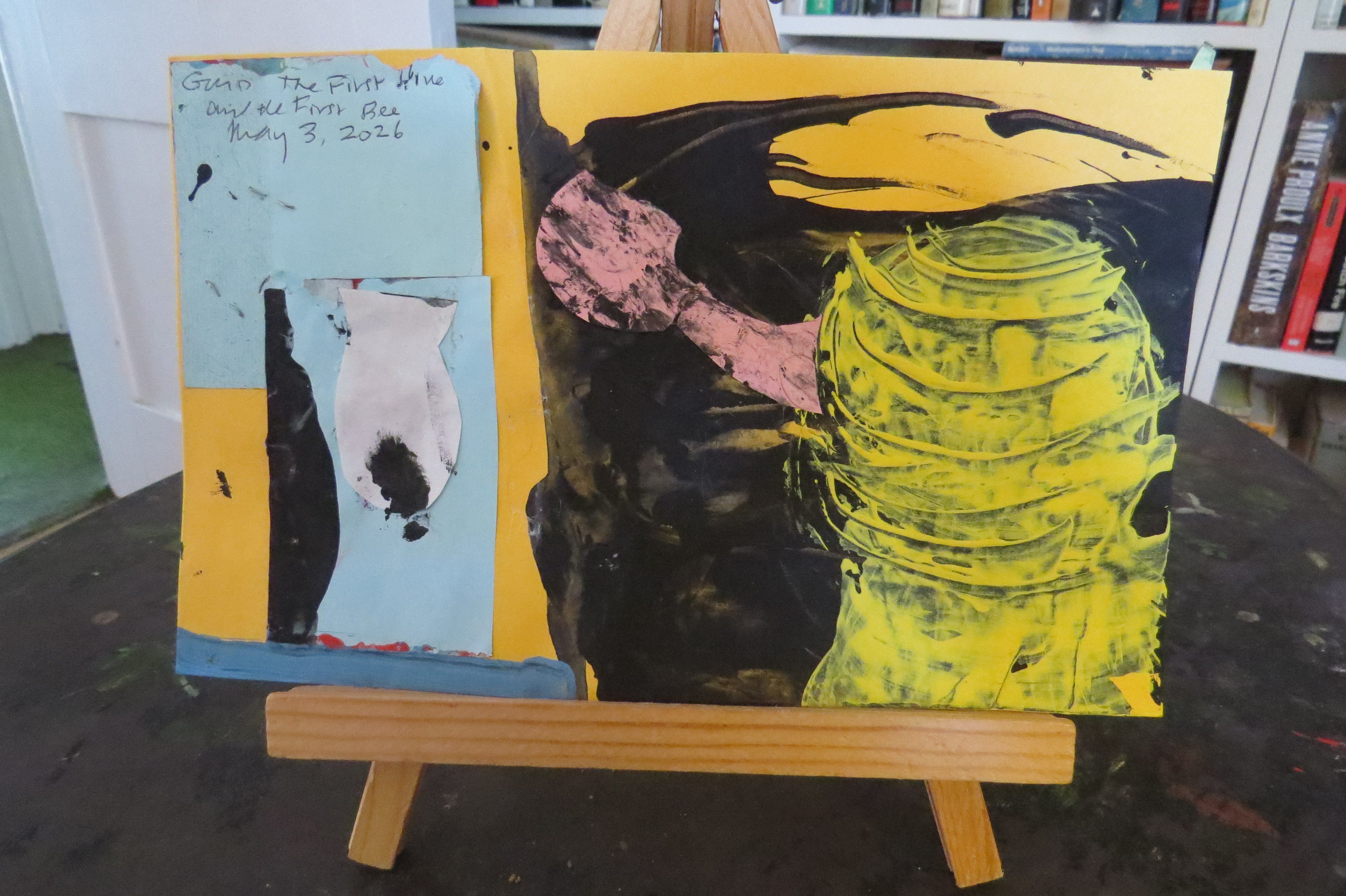
GMD, The First Hive and the First Bee, acrylic and collage on paper, May 3, 2026.
A DRIED BEE
“Would you like to have a dried bee in your study?” Malgorzata shouts up at me from the sunroom at the back of Swan House.
“Sure, I guess,” I shout back down.
For a moment I felt like some fervent Victorian amateur naturalist—like the young cleric in the novella, Morpho Eugenia, in A.S.Byatt’s Angels and Insects (1992). I felt for a moment, that is to say, as if I were presiding over some brilliant cabinet of curiosities I’d been nurturing for years (with fossils, bones, shells, bird skeletons, chunks of minerals and semi-precious stones in their natural state, flies in amber, sharks’ teeth) and housed in a tall, glass-doored case. A dried bee? If I were John Ruskin, I’d be setting about to make delicate drawings of it.
Malgorzata said she’d been tidying up the room and had found the creature on the floor, a fallen bumblebee, along with some desiccated leaves and a few wan lengths of old cobweb. She brought the defunct bee up to me in a shot glass. It sits on my desk next to my computer.
It’s a beautiful thing—though troubling, of course, in its dried, life-leaked rigidity. The bee, my object-bee, is all inspectability now: it’s colouration is exquisite (its shawl-like, sweater-like cowl of golden furriness) as is its eloquent structure (its now lank, now broken proboscis, the intricate engineering of its articulated landing gear).
Every time I look at it, I hear Walter Brennan, Humphrey Bogart’s sidekick, Eddie, in the Howard Hawks’ Hemingway-derived film, To Have and Have Not (1944), asking everybody he sees “Was you ever bit by a dead bee?”
Gazing at my bumblebee in its shot-glass coffin, I get thinking about how little we all know about anything—or at least how little I know about anything. I had to query the Google Oracle, for example, to find out if Bumblebees made honey or not (they do, but because it is really a confluence of nectars, it isn’t as thick or dense as honeybee honey). Do they live in hives? No, but they build nests. Do they possess and honour a Queen? Yup, they do.
No doubt you remember the jokey speculation about how, given their hefty design features, bumblebees really shouldn’t be able to fly (but then neither should 747s, Airbuses and other “heavy” airliners). Here is what Google has to say about that—an item written, as Google-texts go, with an almost unaccountable grace and wit: “Human engineers with big brains said it was impossible for bumblebees to fly. But bumblebees with small brains didn’t know this so continued to fly on in blissful ignorance.” It then suggests the reader follow a number of useful links, in order to learn more about “this story of our ignorance and arrogance.”
There is, of course, a vast and weighty library of books about bees and apiculture. For me, the most delightful of them is The Life of the Bee (1901) by Belgian playwright and poet, Maurice Maeterlinck (Maurice Polydore Marie Bernard, Count Maeterlinck). Maeterlinck writes such utterly delicious prose, I cannot but quote some of it here:
Bees, writes Maeterlinck, “are the soul of the summer, the clock whose dial records the moments of plenty; they are the untiring wing on which delicate perfumes float; the guide of the quivering light ray, the song of the slumberous, languid air; and their flight is the token, the sure and melodious note, of all the myriad fragile joys that are born in the heat and dwell in the sunshine….” (New York: Blue Ribbon Books, 1901, p. 72).
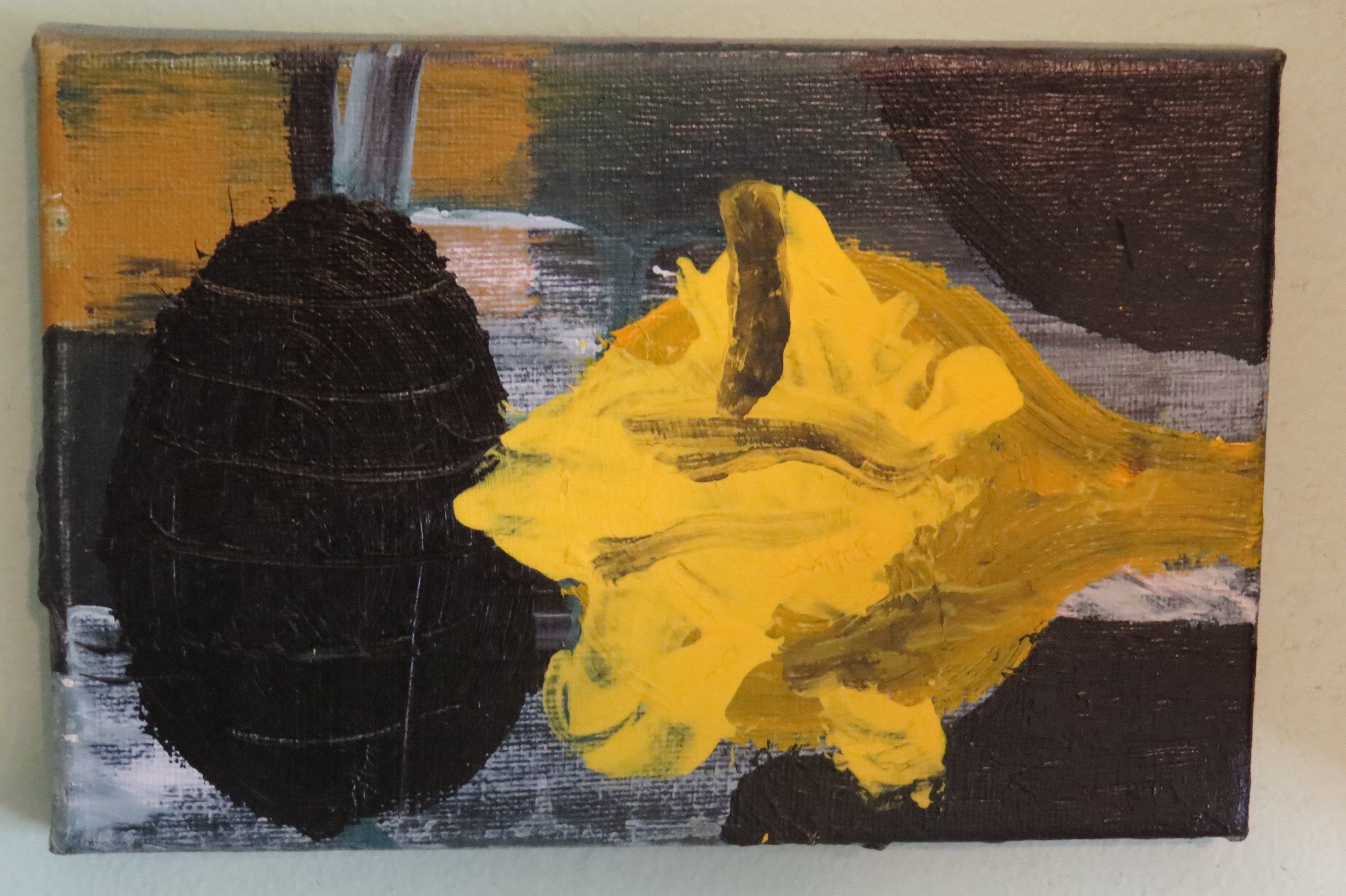
GMD, Hive and Swarm, acylic om canvas, May 11, 2021.
I like bees and I’ve written a lot of poems about them. Here are two of them:
Abstract Bees

abstract bees
make forgetful honeys

gathering geometries
instead of pollen

some of them
leave the sleeping queen

to become architects
and meteorologists

making honeycomb
highrises
and tracing
hive-like tornados

***********************************
Nothing in Your Eye
you dream of winestems
your fingers
cold as glass
you dream of crutches
leaning against the moon
you dream
of mouths that open like doors
or birds
that fly weeping into snowstorms
you dream of houseplants
turning to silver
in the knitted night
or you cease
from dreaming entirely
knowing there is nothing
in your eye
but the seed of a distant bee