
COWING
Sorry for the sluggishness. Been busy being ill. GMD

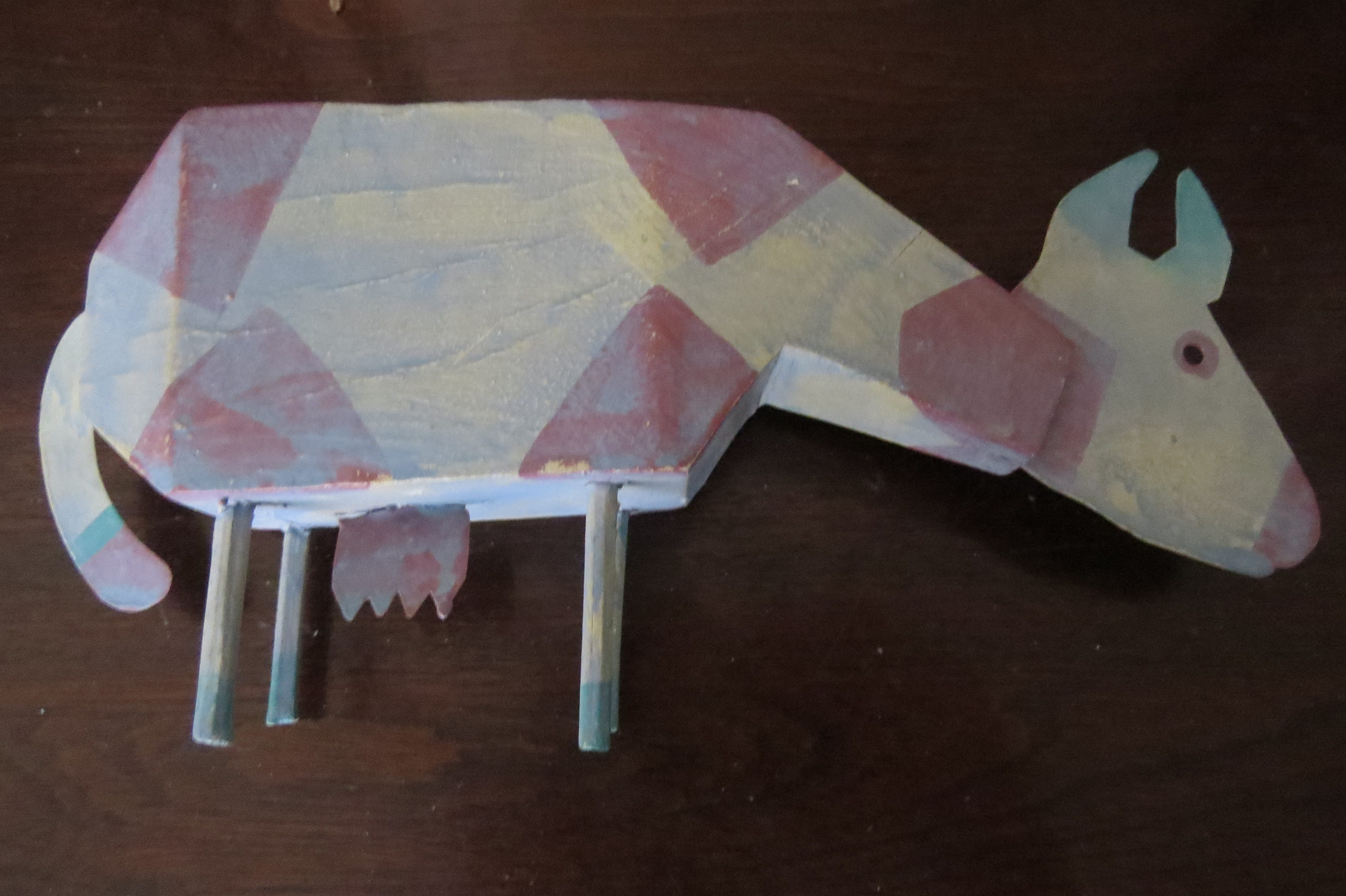
I found this little wood and metal cow and gave it to Malgorzata because she loves cows.
The sticker on it said it was made in the Philippines (somebody probably got four cents for doing so). It comes perilously close, I realize, to being decorative-cute, but is mostly saved from so being, I think, first, by its enjoyable chunkiness, by the solid blockiness of its body, and second, by the really beautiful painting on the sheet metal head, tail and (yes) udder.
The painting of the head—and those exquisite grey-green horns—is positively Picassoid. The horns are beautifully related to one another, formally speaking (the space between them—how each curves up towards the other—is charged with energy). The eye is simply a hole drilled in the metal—but a hole cunningly outlined in a strange, pale mauve that is exactly the colour film director Bernardo Bertolucci once called “inter-uterine” (wheh he was making Last Tango in Paris). The snout is more inter-uterine violet. The creaminess of the head, however, is a variegated creaminess, the paint mottled and scumbled and excitingly brushy, so that the head’s flat (but slightly curved) metal surface seems texturally alive.
The body is a harlequinized patchwork (more Picasso-ness) of carefully located rectangles of dusty mauve, imposed—with considerable deliberation—upon fields of more mottled, washy creams, shot through with (over-painted upon) the same streaky blue-greeness that becomes saturated and intense in the horns.
What surprises me about this little cow’s head, in addition to the skill with which it has been snipped from a sheet of metal and lovingly painted (with what unlooked-for assurance, with what deftness!), is its essential dignity—even nobility. It is this sculptural and graphic “seriousness” of the head that lifts it definitively away from any chance of contamination by an easy, gift-shop seductiveness. Most gift-store animals grimace or smirk. Not this cow. This one ponders.
Cows do seem to ponder. Well, maybe they don’t really, but maybe they inhabit a certain vacuity that reads as profundity.
This one ruminates (as in cud-chewing) upon its own uplifting sonorousness.
This serene little Picassoid cow, which browses now on a bedroom bookshelf at Swan House, is a talismanic cow: it reminds Malgorzata about “cowing.” Cowing is what she calls our drives into the nearby countryside in search of cows for her to consign to her notebooks as pencil drawings or watercolours. When we find a suitable field of grazing cattle, I pull the car over, turn off the engine, and get out the book I’m reading. Malgorzata organizes her paints (unscrews her bottle of water), and makes drawing after drawing, watercolour after watercolour. This is cowing. She finds cows so fascinating she has begun to awaken my interest in the gentle, placid beasts as well.
It seems miraculous to me that there are never two cows the same—a fact underscored by Malgorzata’s resulting drawings and paintings. All those markings, the disposition of colour over their bodies: a uniqueness like that of snowflakes or roses or clouds drifting! The uniqueness of everything, everywhere, all the time.
*******************************************************************************************************
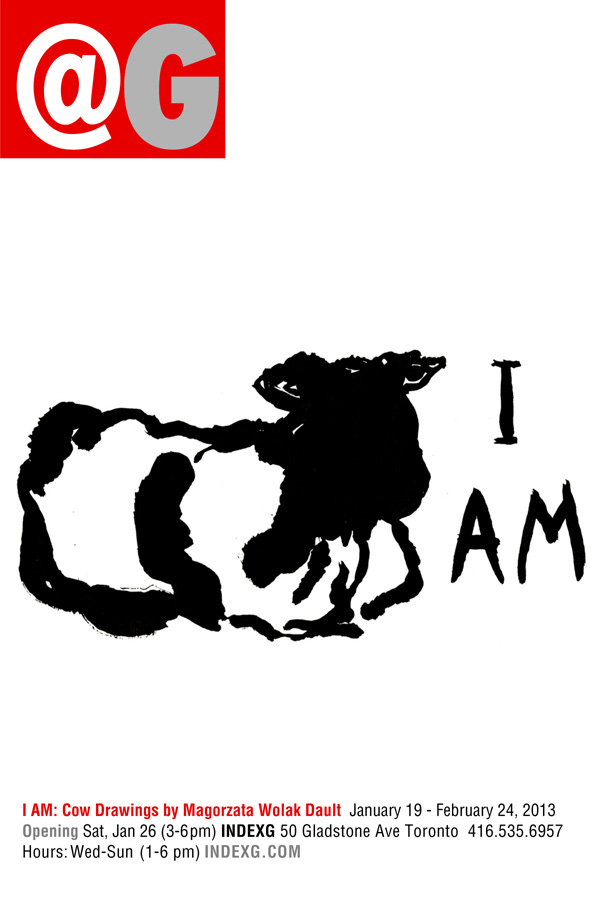
We no longer use milk or eat cheeses or yogurt or (alas) Ice cream (which I love passionately) these days because of Malgorzata’s ever-expanding horror at the commercial abuse and exploitation of cows (ditto chickens. pigs, et al). Her beloved cows were, in fact, the subject of an exhibition a few years ago (in 2013). It consisted of deliciously rough and forceful ink-brush drawings of cows, each bearing the potato-stamped proclamation “I AM!” I AM, so let me be.
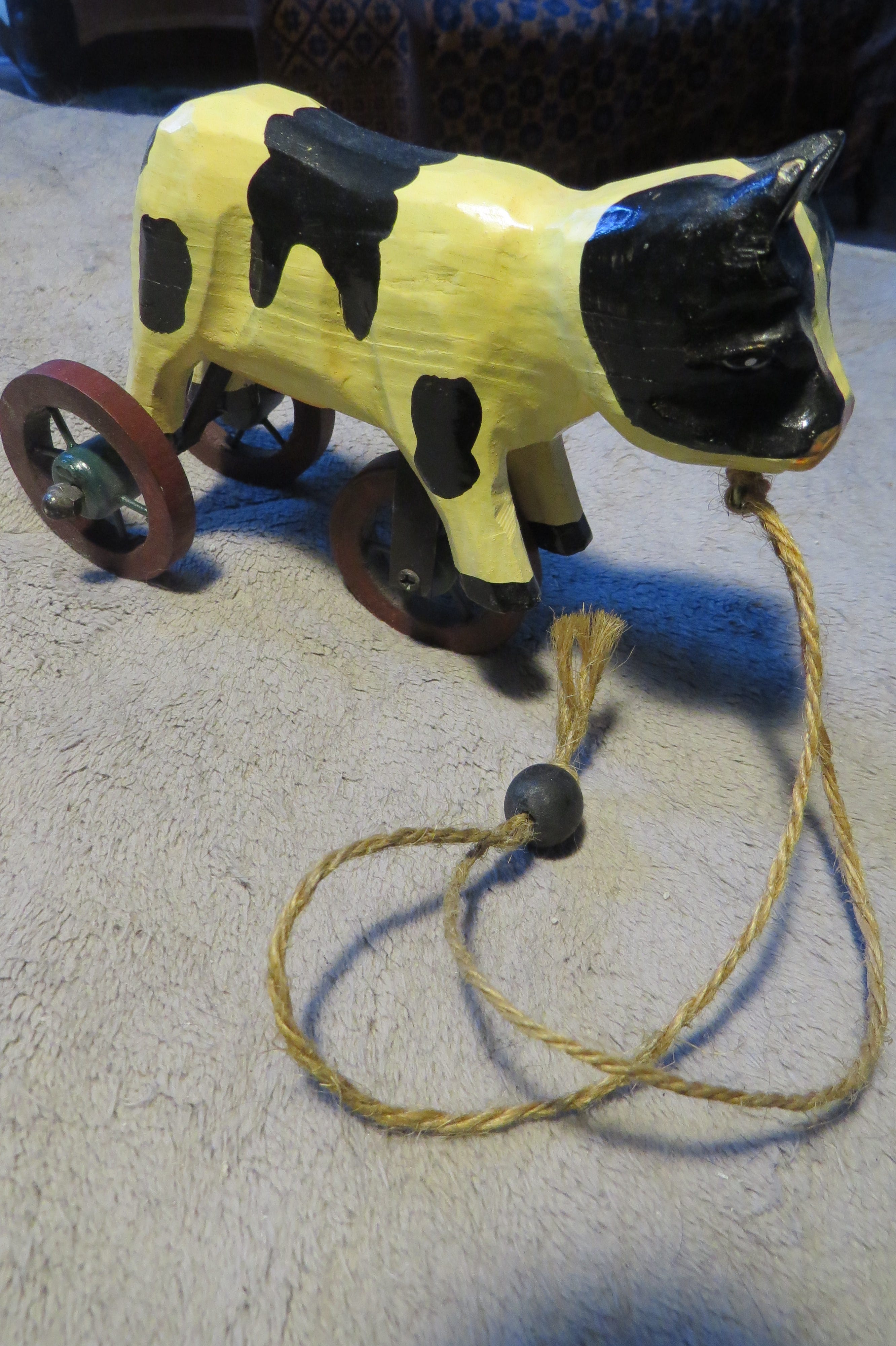
Here is another of the items from her cow pull-toy collection—a three-wheeled Holstein:
I enjoyed your analysis and your division of activity with Malgorzata. Hope you are recovered and can go cowing when asked and stop for a dairy free gelato on your way home.
Adventures in guerilla art appreciation and colour palette intertextuality. Interchromaticity?