
Dragonfly Pail
Dreaming in Embossed Steel

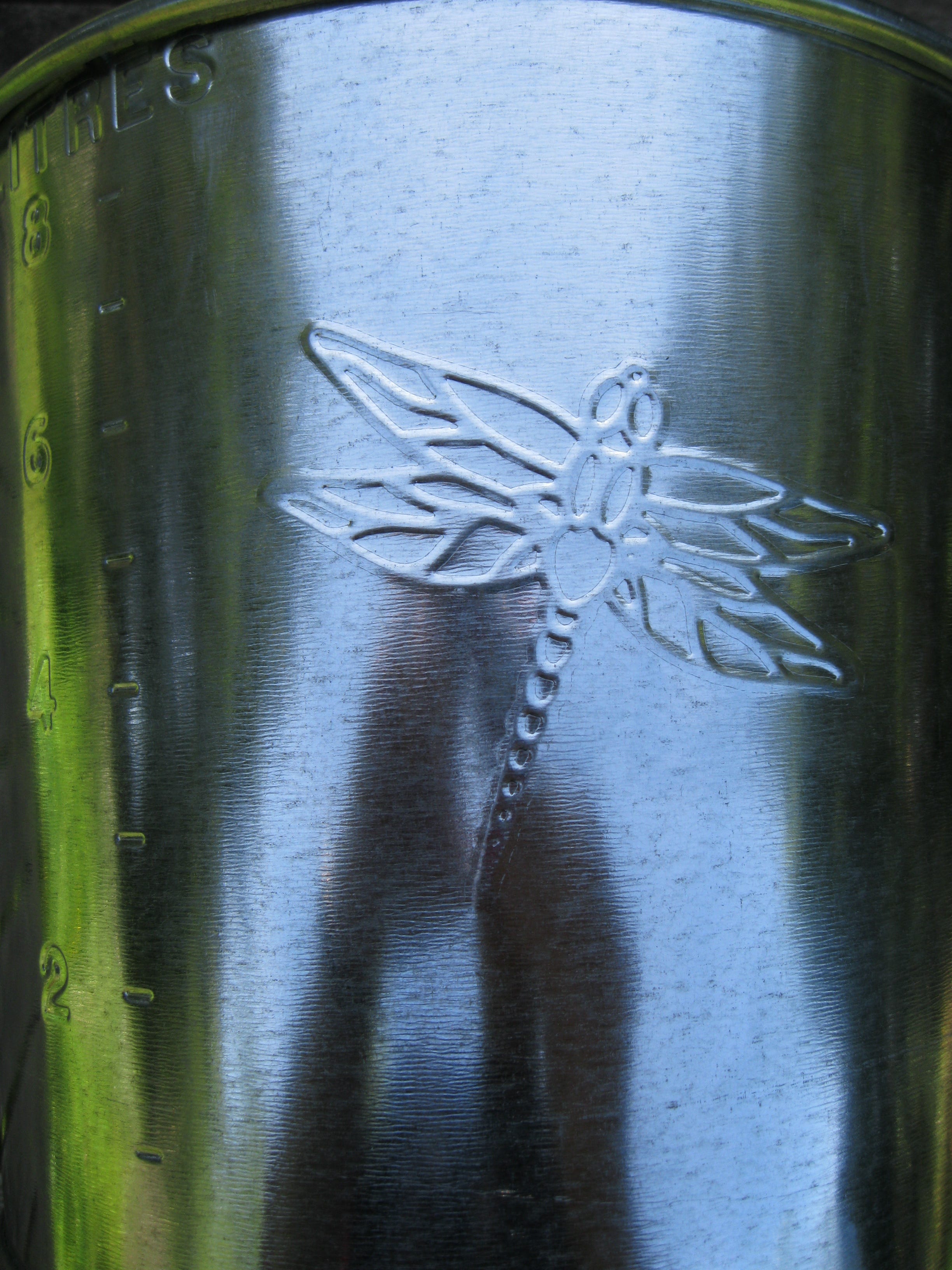
It was while strolling one of the wide aisles at Home Hardware in Napanee, in search, as I recall, of a serviceable pushbroom, I happened to glance down at a jangle of gleaming buckets scintillating on a lower shelf and saw among them a nested stack of shiny metal pails, each of which bore embossings of dragonflies on its sides—both on the outside and—as a moment’s investigation revealed—on the inside as well.
And there was a cunning order to their dragon-flying. The four outside dragonflies were equally spaced around the pail in opposed pairs: two flew upward and two flew downward. And they alternated, rhythmically—one heading up, the next heading down, the third climbing up again, the fourth dive-bombing down once more. And here’s the cunning part: the dragonflies maintain exactly the same pattern and rhythm on the inside of the pail as they do on the outside.
And yet these creatures are embossed into place. They sit delicately on the surface of the metal as if they had just alighted there. But even so, the inner dragonflies are precisely where (and in what attitude) the outside dragonflies are. As if the embossing went all the way through the metal! Embossing doesn’t work that way, does it?
My pail is part of something called the Dragonfly Series, produced by a company—a Canadian company—called Great-West Metal Ltd. Their label also carries the suggestion that we all begin to “Re-think steel”—which I am of course always happy enough to do.
And the pails are indeed made of steel--“passivated galvanized steel.” The word “passivated” was new to me. Apparently—googling a fascinating site called finishing.com will give you the story—it means “de-activated,” which in turn involves an introduction of stainless steel to nitric acid in order to make it less prone to rusting. Alternately, “passivated” can mean an “application of a chromate conversion coating to zinc or cadmium plating.” A further authority says passivation involves the removal of exogenous material and iron from the surface of the stainless steel, thereby “chromium enriching the surface.” All in all, I’m surprised my dragonfly pail cost only $7.99.
The Great-West Metal Ltd is not, as it turns out, entirely without a lyric sense. On the tag affixed to the pail’s handle, the company proudly proclaims that both their watering can and gardening pail “are embossed with dragonfly images for the gardener dreaming of summer.”
As it turned out, I had real difficulty in trying to buy this ruminative, dreamy pail, mostly because it seemed to come decisively as a set of two, one pail so firmly stuck inside another. And they were nearly impossible to separate. I tried a dozen times and I couldn’t do it. So I took it (them) to a beefy Home Hardware employee over in the lumber department—and he couldn’t separate the two pails either,
Nor could two or three of his burly fellow clerks. Finally the deed was accomplished by five employees in a huddle, one of whom finally took a hammer to the recalcitrant pair of pails and viciously knocked them apart.
All this got me thinking about dragonfly love and how the darting, diaphanous creatures mate in the air, one stuck to the other. It seemed so charming that all the dragonfly pails appeared to be similarly engaged—busily making brand new pails, I guess, for gardeners everywhere, dreaming of summer.
Dragonflies are gorgeous and make for a more than appropriate symbol for summers. A great company, a great eye, and a great post, Gary!
You are writing better than ever, Gary.