
GOING DOWN
In Time

There are a lot of old toys in my study here at Swan House, some of which sit dusty on shelves, some of which still gleam brightly with residual playability; some are sober, stern and archival, heavily self-important the way museum-quality artifacts can be, bereft of their museums. Others are borderline-frivolous and, therefore, not a little embarrassing.
Some of my toys are recycled icons of my own boyhood, repurchased during attacks of nostalgia, reclaimed during unapologetic and unredeemable visitations of sentimentality—a mode normally sufficiently remote from me that only certain vintage toys and certain canonical films from the 1940s (Key Largo, To Have and Have Not, My Darling Clementine, The Philadelphia Story, Laura) can evoke it.
I like distressed toys quite a lot. The state of “mintness” does not hold me in thrall, nor does the presence of the toy’s original box do much for me, its desirability among serious, devoted toy collectors notwithstanding.
I like my toys roughed up a bit. I like them to look played with. This does not mean I like them to be romantically ruined: trucks without wheels, locomotives thickly hand-painted in the shrill colours of some unruly boy’s overheated if momentary transformative imagination, cars half-incinerated in some longago conflagration too sad to ponder. I just like my toys broken in, creatively assailed, marinated in their own histories, limping at last to a well-deserved resting place on my shelves.
But there are a few old toys—you come across them now and again—that wear their former toy-lives as living mystery.
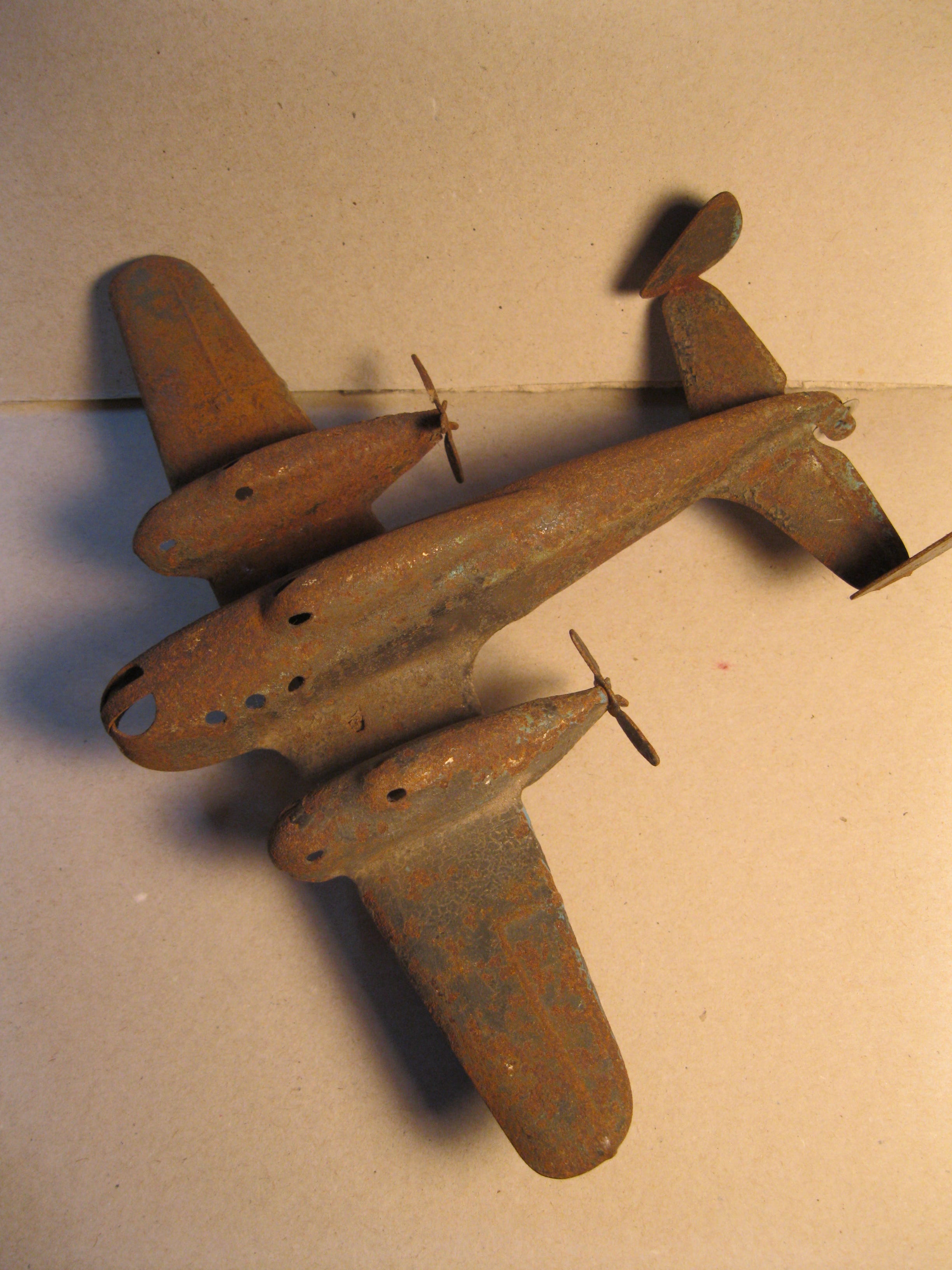
Strangeness, eeriness in toys is not usually a factor of their having been abused. With toys such as these—as, for example, with the rusty aircraft in the photograph—the eeriness has clearly begun during the design process: in the toy factory, long before any kid ever got hold of it.
My strange airplane—with its allover butterscotch-rust, so evenly distributed it looks like a deliberately applied powder-finish for the steel, its push-prop design, and—especially—the fact that there appear to be windows located in what seem to be both passenger cabins and the housings for the craft’s engines simultaneously, can probably claim design heritage within the work of a visionary designer such as Norman Bel Geddes (1893-1958), whose extravagant scheme for a giant “intercontinental airliner of 1940” (1929) was so stuffed with cabin-space that the perforations in its hull, that are apparently its portholes, pop out everywhere—so that all 451 hypothetical passengers can enjoy a vertiginous view of the ocean gliding away far below (I remember a W.C. Fields movie—annoyingly, I can’t remember the name of it—in which a careless Fields actually falls over the tiny inadequate railing running around a porch or verandah protruding from an airliner-in-flight (a scene I always found way more horrifying than funny). And, as with a Bel Geddes airplane (and with such planes as Howard Hughes’s Spruce Goose and even the old workhorse Boeing 747) passengers of my little caramel-coloured ship could sit all around the lower level of the main cabin area while the crew would pursue its piloting from one story up.
My rusty old ship, an aircraft of lost dreams (with its distant echoes of Amelia Earhart’s Lockheed Electra), poignant with the dizzying fragrance of utopian design-futility, stands now on a shelf, nose-down, going down, lost-at-sea, lost-in-a-sea-of-time, vaporized by a lyrical Bermuda Triangle of unworkability. No kid can identify with the aircraft’s built-in doom. Only an adult can, an aging toy fancier, say, with a heart full of schemes and a head bound about by unreachable horizons.
Addendum: Two more hapless old toys:
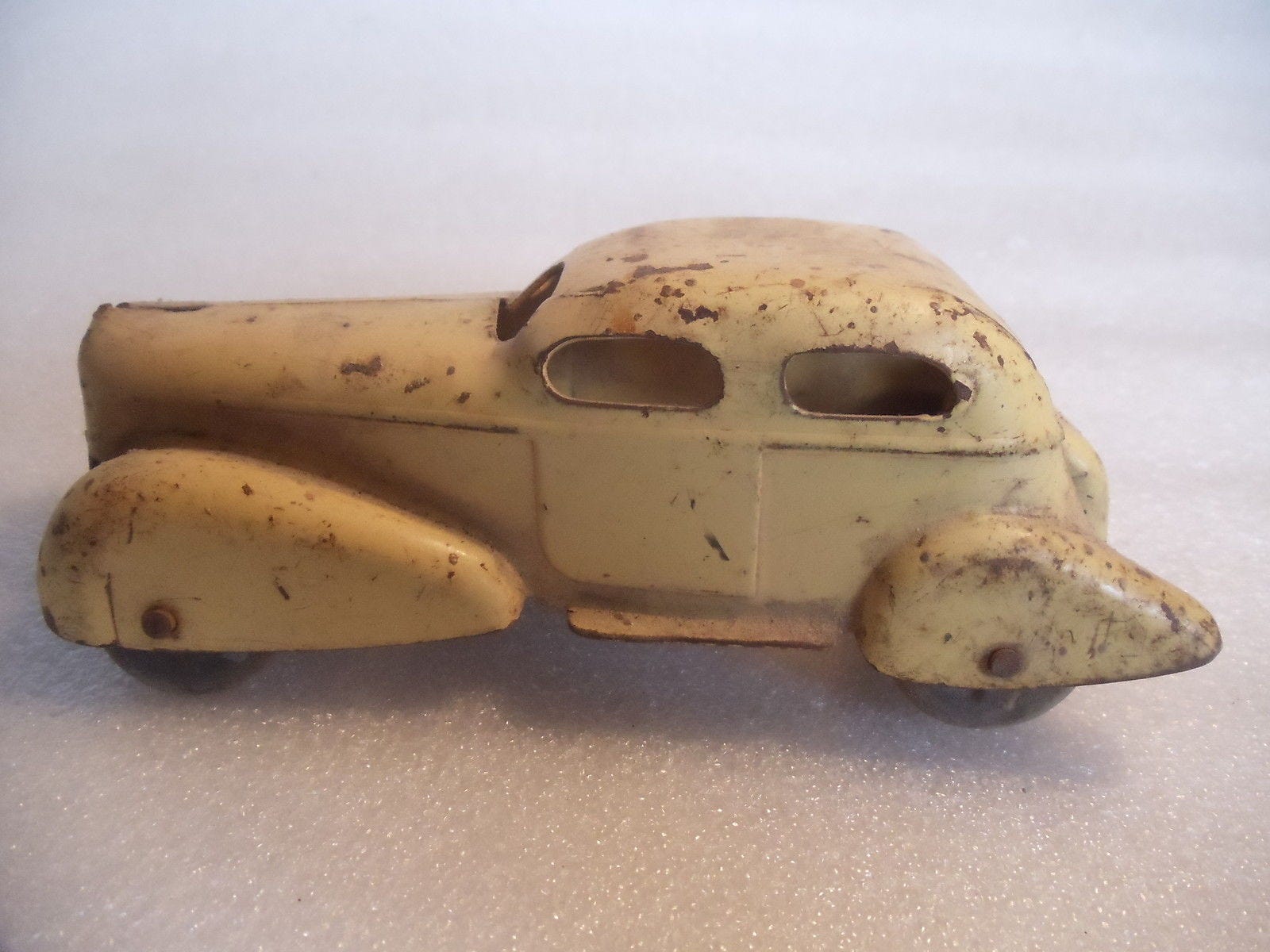
Weathered car
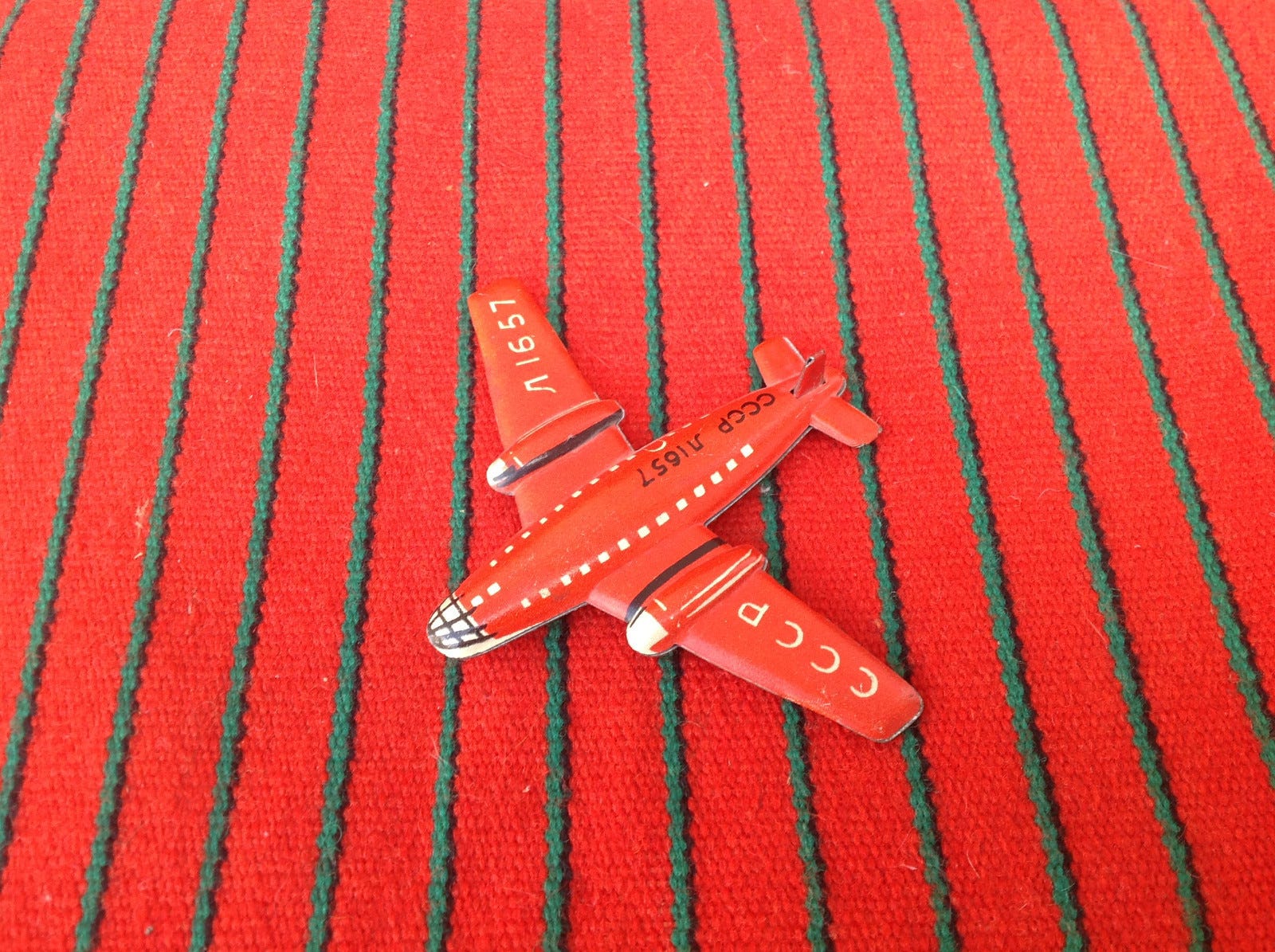
Red Soviet Plane
So wonderful to start my day with this eloquent and moving consideration of toys once creatively used and now lovingly remembered. Thank you !
Such an eloquent toast to your rusty plane.